GOP leader confirms taxpayers on the hook for Trump's ballooning $600M ballroom
Far Left
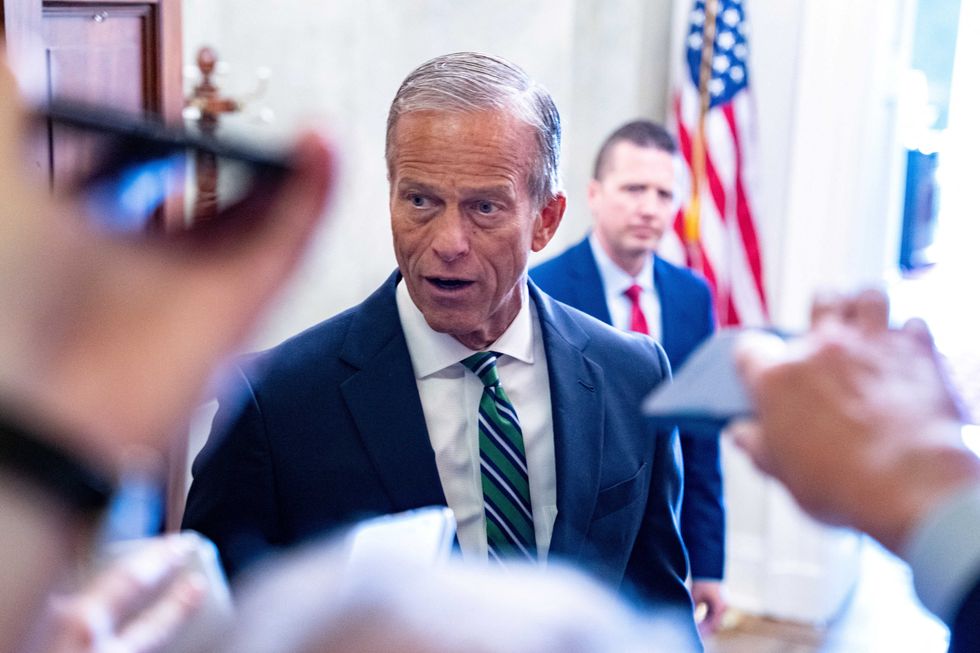
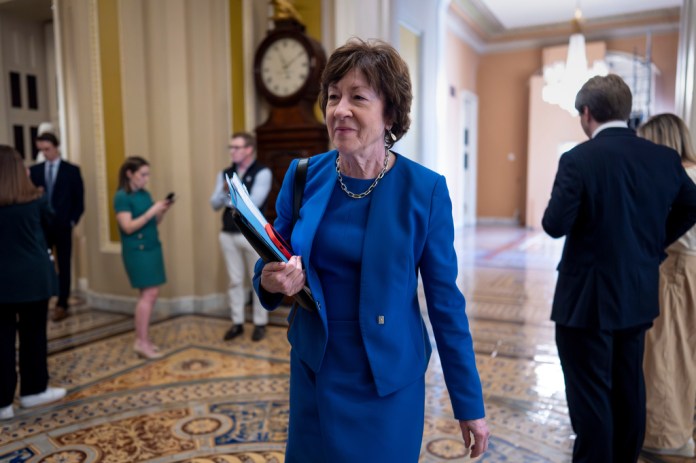
Senate Majority Leader John Thune acknowledged on Tuesday that taxpayers will help foot the bill for President Donald Trump's $600 million White House ballroom.Trump has promised since July 2025 that the project would cost taxpayers nothing. The Washington Post reported Tuesday that internal contractor documents tell a different story.Thune, speaking at a Capitol press conference, didn't dispute it."I do believe that there is certainly some expectation that there would be dollars allocated for that purpose that would go above and beyond the private money that's been raised," he said."There are important security requirements that go with any building project in the White House," Thune continued. "We want to make sure that any additions made down there are completed in a way that ensures that the president and others in his administration are safe and secure."The Post obtained contractor documents showing a March 5 estimate from Clark Construction put the project at $600 million.The taxpayer share breaks down to $155 million from the Secret Service, $149 million from the White House Military Office, and $3 million from the Executive Residence — $307 million in public funds in total.Three weeks after Clark delivered that figure, Trump told Oval Office reporters: "This is taxpayer-free. We have no taxpayer putting up 10 cents."White House spokesman Davis Ingle pushed back Tuesday, saying Trump and donors are funding the ballroom "to the tune of approximately $400 million."Sen. Susan Collins (R-Maine) was among six Republicans who voted during a Senate floor session to require congressional approval before any public or private money could fund the ballroom. She said Trump's original commitment should hold."President Trump indicated that the ballroom was going to be built with private donations," Collins said. "He should keep to that commitment."Three independent contracting experts who reviewed the documents told The Post the costs can't be cleanly separated."I think it's inevitable that it bleeds over. It's one structure," said Stan Soloway, a former Pentagon acquisition official and board chair at the National Academy of Public Administration.
Sen. Ted Cruz (R-Texas) is backing two gubernatorial candidates who don’t have President Trump’s endorsement in the Georgia and South Carolina GOP primary runoffs. Cruz endorsed Georgia billionaire Rick Jackson over Lt. Gov. Burt Jones (R-Ga.) in the governor’s race for the Peach State while supporting South Carolina Attorney General Alan Wilson over Lt. Gov.…
Sen. Susan Collins (R-ME) said she does not regret her vote to confirm Justice Brett Kavanaugh to the Supreme Court despite his vote to overturn Roe v. Wade, reaffirming a position that has become a flashpoint in her closely watched 2026 reelection campaign in Maine. The Maine Republican was asked Friday about her 2018 vote […]
The Senate narrowly rejected a war powers resolution on Iran as President Trump touts a framework agreement with Tehran to end the monthslong conflict.
Rep. Kevin Hern (R) is on track to succeed Homeland Security Secretary Markwayne Mullin representing Oklahoma in the Senate. Hern, who is backed by President Trump, effectively cleared the GOP field with his entrance into the race after Mullin’s appointment. He is almost certainly going to win the seat in the ruby red state this…
According to an ex-presidential aide, President Donald Trump’s fishing expedition against one of the Democrats’ presumed 2028 election front-runners, California Gov. Gavin Newsom, proves “no one is safe” from the Republican president and his politicized DOJ.“Federal agents abusing the powers that they had when surveilling civil rights leaders have taken off after the governor of California, which means, unless you're not too bright, if they can do it to Gavin Newsom, they can do it to anybody,” warned Steve Schmidt, who advised Republican president, George W. Bush. “And thinking about that, how close is it that we came to the US military being deployed on the streets, an ICE army behind them or in front of them, commanded by Stephen Miller, with the power to detain whomever they wanted, wherever they wished?”Adding that Trump has reportedly talked about eliminating the writ of habeas corpus, which guarantees the government “can't just lock you up without reason or cause and has existed in English common law for a thousand years,” Schmidt added that Trump aspires to transform America “from a republic to a police state.” Comparing Trump’s order to investigators to find something about Newsom and/or his family members, Schmidt added that this is like Russia under its dictator, Vladimir Putin.“It is unacceptable, and it must not be stood for,” Schmidt declared. “This is why, in the months ahead, as the contours of the debate take shape, there can be no compromise on this simple, fundamental, absolutely important principle” — namely that, unlike the forgiving approach of President Joe Biden’s Attorney General Merrick Garland, after Trump there should be “no more appeasing this lawless evil. Here, in these United States, there will be accountability for every federal agent, every corrupt federal official, from Trump on down, who has made the rule of law in this country a mockery and has trampled on the liberties of the American people, including the governor of California and his lovely wife Jennifer, who deserve better from their president, and better from their country, than to be persecuted for speaking out and participating and leading and standing up.”In a Monday appearance on MS NOW senior investigative correspondent Carol Leonnig revealed that a fellow reporter, Erum Salam, learned Trump’s Department of Justice is trying to find any case it can to use against him."First off, I want to say that we have from sources two really important nuggets," Leonnig said. "One is that the central district of California, the U.S. district attorney's office in the central district, has been pressing the line prosecutors to come up with a case against Gavin Newsom."Schmidt has also warned more broadly about the loss of faith in American political institutions that has occurred during Trump’s presidency.“There was a time in America when public disgrace meant something,” Schmidt said. “A man caught lying to the public would resign. A politician caught in corruption would retreat from public life. A leader who dishonored his office would feel the sting of judgment from neighbors, colleagues, family members and strangers.”
California Governor Gavin Newsom accused President Donald Trump Monday of having his family investigated by the Department of Justice. Newsom released a video statement saying he’d been added to Trump’s “hit list,” claiming that federal investigators had launched a probe into him because he was considering a presidential run in 2028.“In recent days, federal agents have knocked on the doors of family, friends, and former employees. Not because they found a crime. Because they are simply trying to find one,” Newsom said. “They’re demanding records. They are abusing the grand jury process. Digging through years and years of random documents,” Newsom said. “Donald Trump isn’t just coming after me because of my mean tweets. He’s coming after me because I am considering running for president.”Newsom claimed that federal investigators were also investigating his wife, actress and activist Jennifer Siebel Newsom, “who has done nothing wrong, other than having the temerity to advocate for what she believes in.”There are actually several ongoing investigations related to Newsom, a source familiar with the situation told Semafor’s Shelby Talcott. The investigations reportedly involve his wife’s taxes and his chief of staff Nathan Barankin. Those did not originate from the main DOJ but stem from Sacramento, involving whistleblowers, according to the source. This revelation comes a year after Trump threatened to have Newsom arrested, amid an escalating feud about the president’s illegal deployment of National Guard troops in Los Angeles.Trump has bragged about his supposed “right” to weaponize the Department of Justice, and openly directed the DOJ to investigate his political enemies New York Attorney General Letitia James, Senator Adam Schiff, and former FBI Director James Comey. All of those cases crashed and burned. Trump had also been investigating former Federal Reserve Chair Jerome Powell, although he dropped the case in order to get Powell’s replacement approved by the Senate. It’s not clear that the administration won’t resume targeting Powell.And just a week ago, Vice President JD Vance referred Minnesota Governor Tim Walz to the DOJ for a criminal investigation into allegations of fraud.This story has been updated.