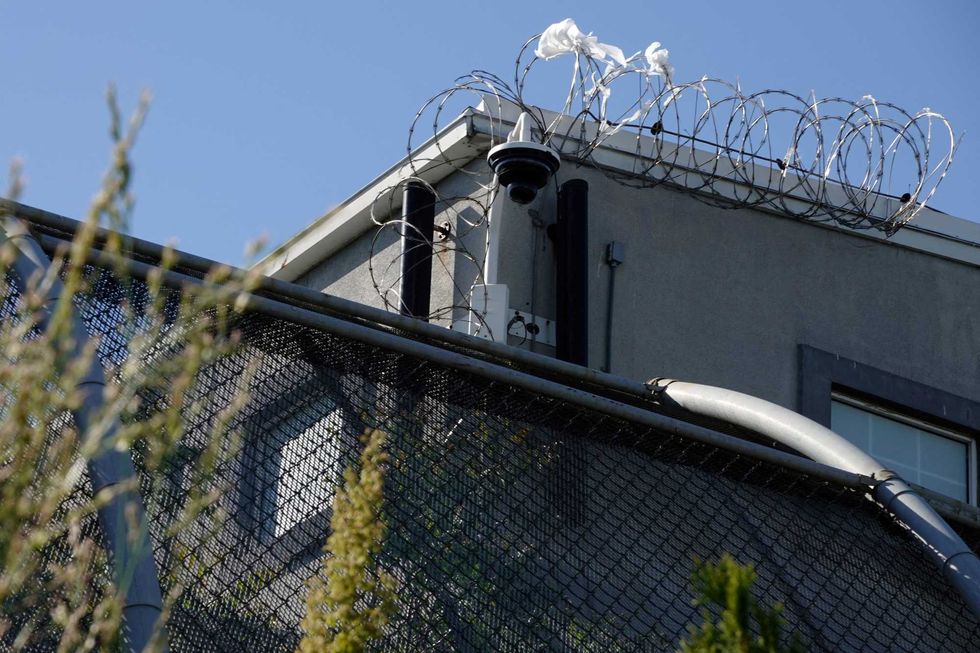
Fury as Trump admin keeps cities in the dark on plans for massive ICE detention facilities
Source: Raw Story · Bias: Far Left
Summary
Communities fight ICE detention centers, but have few tools to stop themby Kevin Hardy, Daily Montanan February 17, 2026Outrage erupted last month when Oklahoma City residents learned of plans to convert a vacant warehouse into an immigration processing facility.Making matters worse was the secrecy of the federal government: City leaders received no communication from U.S. Immigration and Customs Enforcement aside from a mandated disclosure related to historic preservation.Planning a major development without city input is antithetical to the in-depth, sometimes arcane permitting, planning and zoning process in Oklahoma City. Mayor David Holt, a former Republican state senator, said those land use decisions are among the most crucial of any municipal government.“For any entity to be able to open a detention center in our communities, potentially next to neighborhoods or schools, regardless of your views on immigration policy or enforcement, is very challenging, because that’s a very high-impact use, and that’s the kind of thing that we would expect to talk about,” he told Stateline.Communities across the country are facing similar prospects as ICE undertakes a massive expansion fueled in large part by the record $45 billion approved for increased immigration detention by Congress last summer.During President Donald Trump’s second term, ICE is holding a record number of detainees — more than 70,000 as of January — across its own facilities as well as in contracted local jails and private prisons. ICE documents from last week show plans for acquiring and renovating 16 processing sites that hold up to 1,500 people each and eight detention centers that hold up to 10,000 each, for a total capacity of 92,600 beds. The agency also has plans for some 150 new leases and office expansions across the country, Wired reported.But ICE’s plans to convert industrial buildings — often warehouses — into new detention facilities have recently faced fierce opposition over humanitarian and economic concerns. From Utah to Texas to Georgia, local governments have sought to block these massive facilities. But with limited legal authority, city and state officials have turned to the court of public opinion to deter private developers and the federal government.We all have a clear, unified position that really crosses party lines, and then we also have a clear understanding of how limited our options are.– David Holt, mayor of Oklahoma City and president of the U.S. Conference of MayorsHolt, who is the president of the U.S. Conference of Mayors, a nonpartisan organization representing the more than 1,400 leaders of cities with populations of 30,000 or more, said cities have little legal recourse over the ICE facilities.“We all have a clear, unified position that really crosses party lines,” he said, “and then we also have a clear understanding of how limited our options are.”Local leaders often cite the U.S. Constitution’s supremacy clause, which says federal laws supersede conflicting state laws. That leaves cities with limited influence over projects that could take industrial space off tax rolls, cause new strains on city services and raise serious humanitarian concerns given the Trump administration’s aggressive immigration enforcement, including the high-profile killings of two Americans in Minnesota.Facing bipartisan opposition, the out-of-state owner of the Oklahoma City warehouse ultimately decided to end talks of selling or leasing its warehouse to the federal government.Similar public pressure has proved effective in reversing plans in several other cities: In late January, a Canadian firm said it would not proceed with a planned sale of a Virginia warehouse after it faced calls for a boycott from Canadian politicians and businesses. In Mississippi, U.S. Sen. Roger Wicker announced the federal government would “look elsewhere” after he spoke with Department of Homeland Security Secretary Kristi Noem, who oversees ICE. Wicker, a Republican who said he supports immigration enforcement, echoed local economic concerns of a project planned in Byhalia.Some officials have welcomed the new facilities: Missouri Republican U.S. Rep. Mark Alford has lobbied to land a detention and processing center in his district. And last week, a Maryland county approved a resolution expressing its “full support” for ICE, which is considering purchasing a warehouse there, despite local protests. But most communities have fought them.Proposed Oklahoma City ICE facility is off the tableNeither DHS nor ICE responded to Stateline’s questions.Holt said the discussion resembles other local development concerns where NIMBY — short for Not in My Backyard — is a common description of opponents.“There are plenty of people who are very law-and-order and supporters of law enforcement who don’t want a jail next to their house,” he said.
Related Coverage
- Feds tout 'well-prepared' Trump fair after blistering heat wave hospitalized attendees (Far Left — Raw Story)
- Taylor Swift and Travis Kelce married at New York City’s Madison Square Garden (Center Left — US news | The Guardian)
- Trump announces new pardons after privately weighing "Diddy" clemency, sources said (Center — Politics - CBSNews.com)
- Trump Heads to Mount Rushmore, Where He Wants to See His Face (Center — WSJ.com : U.S. News)
- 'Total disaster' at Trump's fair as scorching heat leaves 7 on 'advanced life support' (Far Left — Raw Story)
- Trump, ballot seizures and a ‘declaration’: Gavin Newsom teases tiresome July 4 address to the state (Right — New York Post)
- 'Not mentally well': MAGA suspects Trump sabotaged by liberals armed with weather machines (Far Left — Raw Story)
- 'God is angry': Internet bemused as Mother Nature comes for Trump's Mount Rushmore speech (Far Left — Raw Story)
More Headlines From February 17, 2026
- Republicans handed major loss in court over swing state voter lawsuit (Left)
- Trump uses Jesse Jackson’s death to argue he’s not 'a racist' (Left)
- GOP warned more 'defections' imminent as 'weak' Pam Bondi hands rebels a win (Far Left)
- Trump’s Jesse Jackson praise immediately backfires: 'Everything he fought for is at risk' (Far Left)
- Trump's reckoning could come via a new 'trap of his own making': analysis (Left)