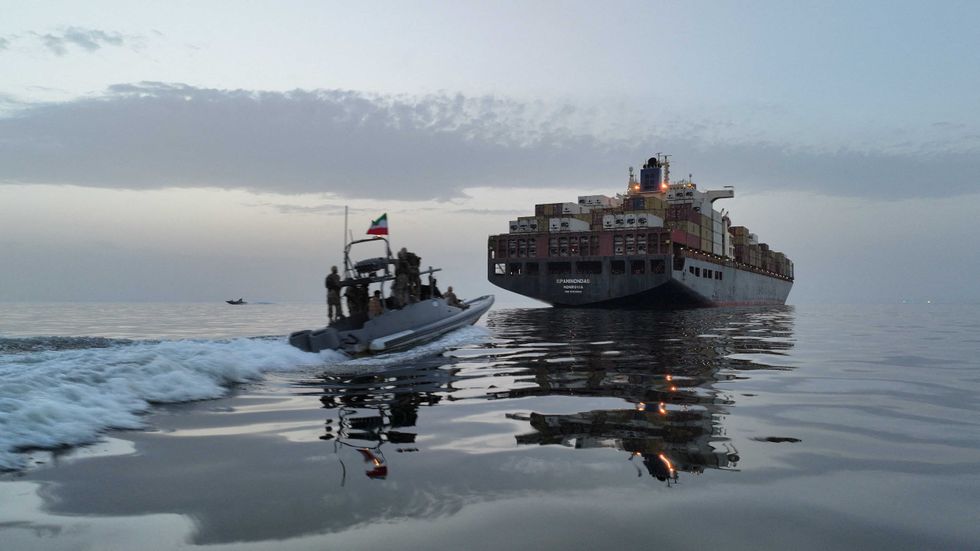
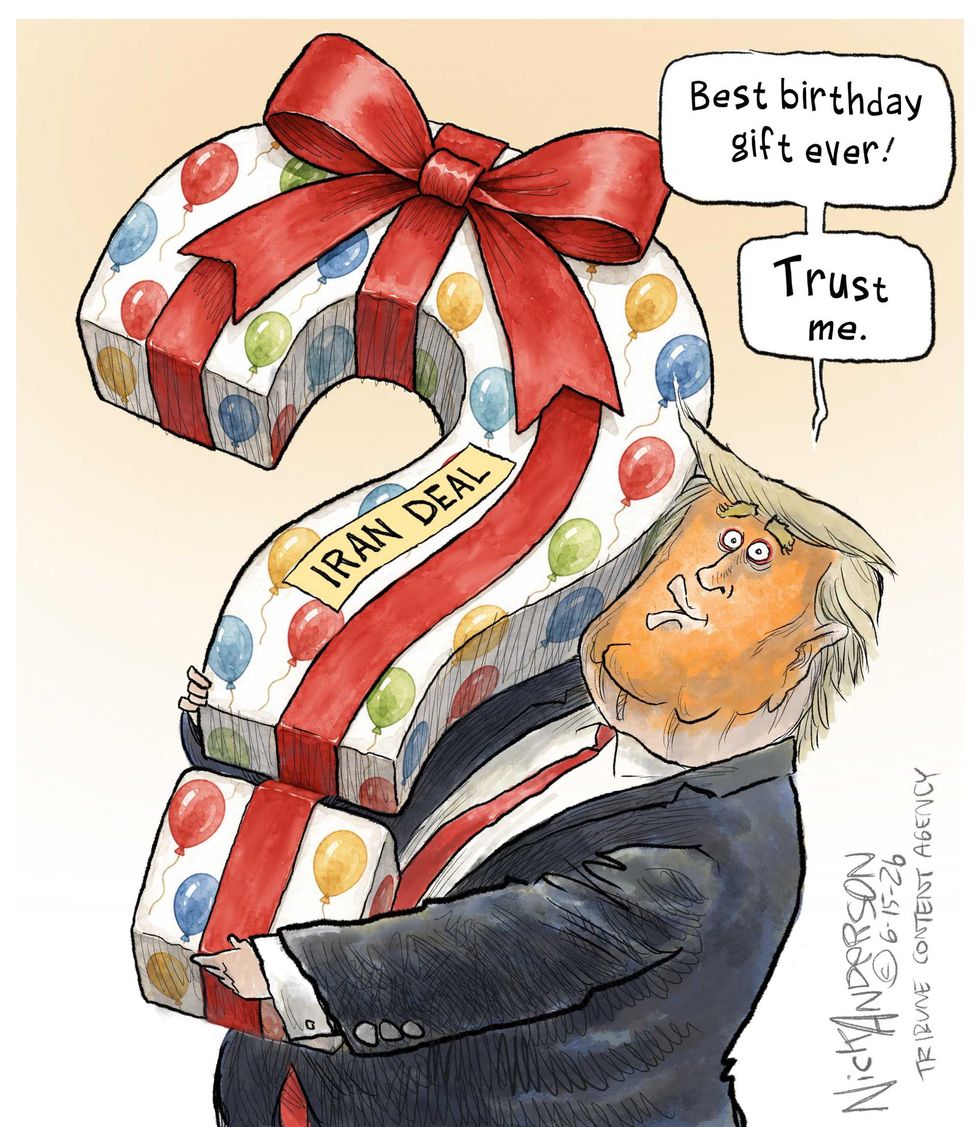
President Donald Trump has touted the framework to end his war with Iran as a great deal for the American people, and he and his officials have insisted Iran won't "get a dime" until they follow through on their obligations. But new reporting suggests Iran has already received money under the table.According to a report from Israel Hayom, a month ago, the Trump administration secretly approved a deal where Qatar transferred cash to Iran in exchange for a promise of safe passage for Qatari ships through the Strait of Hormuz.This clandestine deal "dovetailed with Doha's interest in opening a direct channel of communication with Tehran, which began to tighten after the ceasefire. Qatar, fearing a renewed Iranian attack on its facilities after one of its gas installations was attacked during the war, sought to buy security quiet," said the report. It also came as the U.S. was desperate to get traffic moving through the Strait, as the shutdown of the critical shipping artery has disrupted world oil exports.The reporting instantly provoked an explosive reaction from social media commenters."CORRUPT," wrote former Rep. Adam Kinzinger (R-IL), a former lieutenant colonel in the Air National Guard."Bloody hell — US colluded with Qatar and Iran to undermine its own blockade. This is nuts," wrote Dr. Nafeez Ahmed, a British reporter with the Byline Times."I believe it. The lies and spin have been since day one," wrote podcaster Peter Grandich. "But as long as the stock market remains up and family and friends make billions, to heck with the long-term implications."
Israeli Prime Minister Benjamin Netanyahu is under fire from even his own allies who slammed the current US-Iran peace deal as a wreck that fails the needs of the Jewish state.
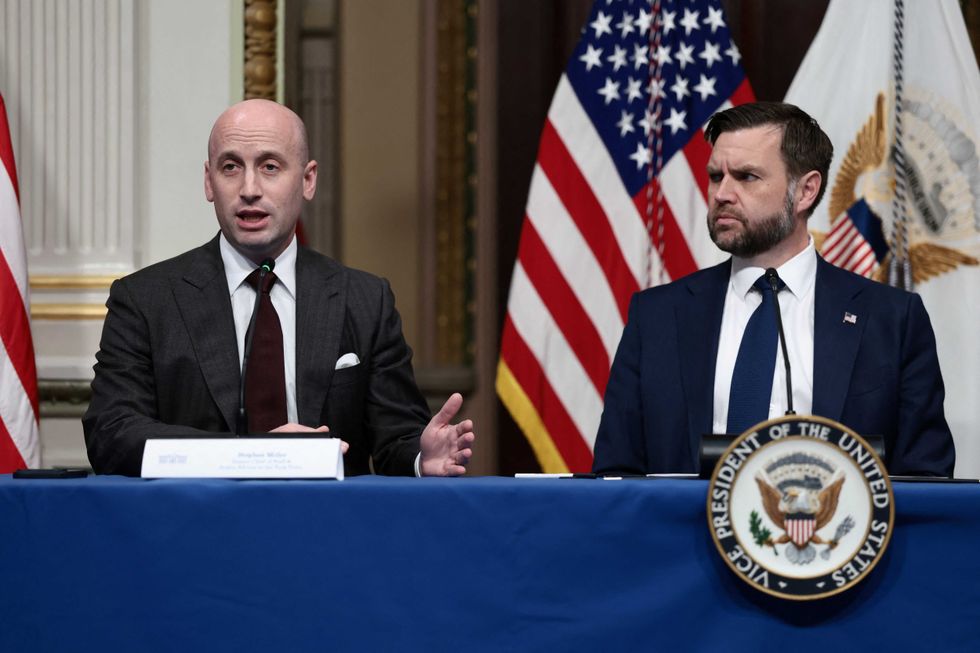
MS NOW host Joe Scarborough highlighted reporting from New York Times journalists Maggie Haberman and Jonathan Swan's forthcoming book "Regime Change," detailing unconstitutional proposals by Trump administration officials. Deputy Chief of Staff Stephen Miller proposed suspending habeas corpus to accelerate mass deportations. Furthermore, both Miller and Vice President JD Vance pushed President Donald Trump to invoke the Insurrection Act in Minnesota after federal agents killed two innocent American citizens during protests. Scarborough characterized these as clear examples of illegal acts or conspiracies to commit illegal acts that will become subjects of future criminal investigations and prosecutions. He noted the White House cannot pardon the entire government, leaving officials vulnerable to questioning under oath. Scarborough emphasized that the book's damaging revelations explain why the White House is melting down, stating that numerous officials will eventually have to testify about what occurred behind closed doors.Watch the video below. Your browser does not support the video tag.
Rain or shine, thousands of fighting fans were pumped to celebrate America during the UFC Freedom 250 event on June 14, where cage fighters duked it out in a stunning display on the White House South Lawn. But one fighter, who wasn’t invited to the controversial event, appeared to cause a commotion at a Fan...
Since it was announced on Sunday that the U.S. and Iran had struck a peace deal, experts have found no shortage of shortcomings in the agreement. Now, reporters and Republican lawmakers are pointing out that confusing aspects of the deal may not only provide Iran with a major gift, but represent a major betrayal of President Donald Trump’s own much-vaunted policies regarding the adversary. This is according to Punchbowl News senior congressional reporter Andrew Desiderio in response to an assertion by Politico senior foreign affairs correspondent Nahl Toosi. After listening in on Trump officials’ call regarding the Iran deal, Toosi declared he was “in some ways more confused now than before.” He went on to list several aspects of the call that didn’t add up, but one point stood out in particular. As he explained, “They do not seem to have a good grasp of U.S. sanctions law. They laid out the possibility of a $300 billion investment fund for Iran. And one said at one point that ‘the sanctions relief is not tied specifically to any particular conduct. It's tied generally to them behaving more appropriately, and obviously the thing that we care the most about is the nuclear program.’ But sanctions are specific to particular conduct.”In other words, Trump officials claim that, in order to pay Iran $300 billion — the legality of which depends on the reduction of sanctions — it is going to relieve sanctions based on the vague concept of good behavior rather than specific actions. This is a problem, however, because the sanctions — which were set in place by Congress — are tied to specific actions. So the White House’s claims in this regard are either illegal or nonsensical. And according to Desiderio, it gets even more muddled as “many Republicans have pointed out to me that this type of sanctions relief likely requires the IRGC to be de-listed as a terrorist organization under U.S. law. As someone who covered the Rob Malley-led Senate briefings in 2022, not even the [former President Joe] Biden admin was willing to do this.”This refers to the Islamic Republican Guard Corps, the nation’s top military body, which has been listed as a terror group since Trump deemed it so in 2019. Such a designation raises restrictions on what kind of resources can be provided to it. For Trump to backtrack on this policy — a move his administration bragged about vocally at the time — not only suggests the failure of his foreign policy, but opens the Iranian regime to trade and support it’s been denied for nearly a decade while lending it greater political legitimacy. The harms raised by de-listing the IRGC as a terror group are so widely understood that, as Desiderio noted, not even Biden — who overturned huge swaths of Trump’s foreign policy — would make the change. Furthermore, this move would not only clash with U.S. allies in the EU — which declared the IRGC a terrorist organization after it massacred somewhere between 6,000 and 35,000 protesters in January — but also contradict one of the administration’s other many suggested justifications for the war: protecting the Iranian people from its government. And as Toosi noted, there were several other contradictions revealed in the White House call. As he explained, “They seemed to act as if the US had won this confrontation, whereas the Iranians seem to think they have the upper hand.” Officials asserted that troops would remain in the region en masse even though the deal calls for reductions. And they suggested that the new Iranian leadership was eager to give up nuclear capabilities, claiming that it was the previous Supreme Leader who had held up such a plan, which is the opposite of what most analysts believe. Then there was their seeming total ignorance regarding the Joint Comprehensive Plan of Action (JCPOA), otherwise known as the Iran Nuclear Deal, which Obama struck, then Trump tanked. “They said ‘one of the really cool things and interesting things about this entire process is that we actually have a direct relationship with a number of people at the highest levels of the Iranian government. That really hasn't happened in 47 years of our relationship with Iran,'” posted Toosi. “This is not a huge thing, but it suggests they haven't really done their research on US-Iran relations. (See: JCPOA talks.)...Why do I suspect they haven't really studied the JCPOA and Iran-US history? Because of statements like this: ‘If you go back to the JCPOA, the Supreme Leader just doesn't sign these agreements.’ But nobody signed the JCPOA. It was a political arrangement, not a signed accord.”
The Trump administration doesn’t appear to have its story straight on the tentative peace deal between the U.S. and Iran.President Trump said on Monday that “the deal is already signed and the strait is already partially opened,” referring to the Strait of Hormuz. “Ships are starting to go out now, and on Friday it will be completely opened.” But senior U.S. officials told The Wall Street Journal at the same time that it could take over two weeks for normal shipping traffic to resume in the strait. On top of that, a spokesperson for the Iranian Foreign Ministry said that a “maritime service fee” would still be charged for ships traversing the strait.Those same U.S. officials also said that the full text of the deal would be released within two days, contradicting Trump, who said he expected the full text of the deal to be released by Friday.A major sticking point for Iran, the end of Israeli strikes on Lebanon, is being disputed by Israeli officials. Israeli Defense Minister Israel Katz said Monday that the Israel Defense Forces wouldn’t withdraw from southern Lebanon, and far-right National Security Minister Itamar Ben-Gvir said that “Israel is not subordinate to the United States, and we are an independent and sovereign state.”“We must not withdraw from any territory that our fighters have occupied and cleared of terrorist infrastructure,” Ben-Gvir added. Trump already criticized Israel on Sunday for airstrikes on the southern suburbs of Beirut “on a special day when we are so close to a Peace Deal with Iran.”Trump and Vice President JD Vance digitally signed the tentative deal on Sunday, and a formal signing ceremony is scheduled to take place in Switzerland on Friday. But no U.S. allies in Europe, or the G7, have seen the full text, nor has Israel or anyone in Congress. Their objections could still hamstring the agreement, especially if Trump has made unacceptable concessions.
CLICK HERE TO WATCH RIGHT NOW!
The post Watch Live: Trump, Vance, and Speaker of Iranian Parliament Have Officially Signed Peace Memo and More! The WAR Zone Podcast With Wayne Allyn Root Presented by The Gateway Pundit appeared first on The Gateway Pundit.