Bannon promised ICE at polls — now these states are passing laws to stop it
Source: Raw Story · Bias: Far Left
Summary
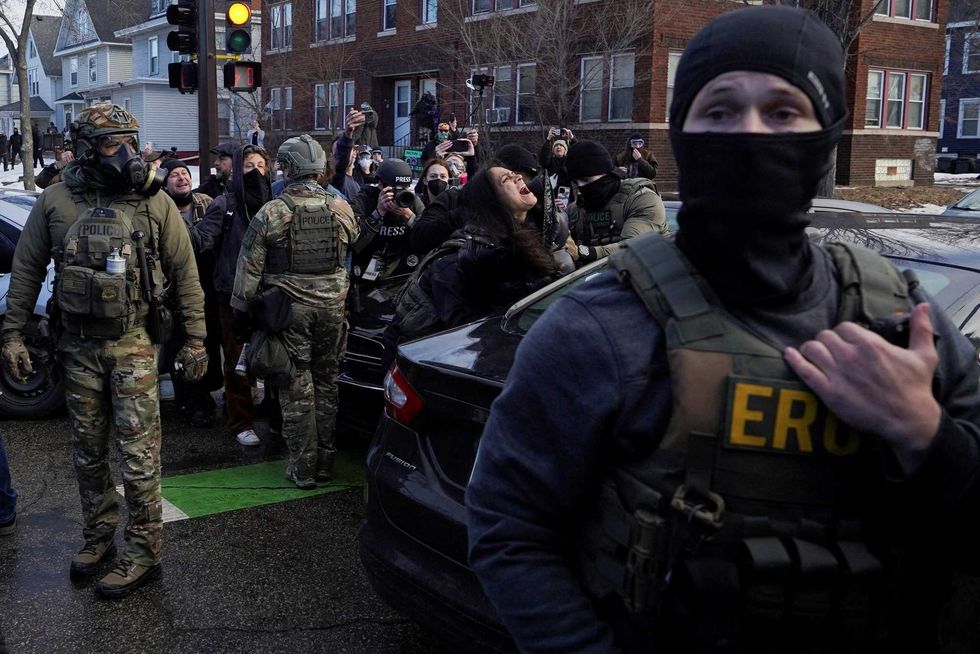
Several Democratic states are moving to bar federal immigration agents from being near polling places and other election sites, amid persistent worries that President Donald Trump will use federal law enforcement or the military to disrupt the midterm elections.Measures to restrict federal agents from operating at or near election-related locations have been offered in more than half a dozen states, according to a Stateline count. While the proposals vary, they broadly seek to combat the prospect of chaotic confrontations between federal agents and voters this November.A federal law dating to the end of the Civil War already bans sending the military or other “armed men” to polling places, except to repel armed enemies of the United States. The U.S. Constitution also gives states — not the president or federal government — the responsibility for running elections.But Trump’s calls to nationalize elections, his promise to impose voting restrictions with or without Congress, and his history of working to overturn the 2020 presidential election is prompting some Democratic state lawmakers to act. Adding to lawmakers’ fears is the FBI’s January seizure of ballots from the 2020 election in Fulton County, Georgia, and U.S. Department of Justice lawsuits against dozens of states for copies of their voter rolls that include sensitive personal information.The president’s party typically loses ground in Congress in midterm elections. Given that, Democrats fear Trump is laying the groundwork to block or cast doubt on a losing outcome.“When the president says he’s going to break the law, I actually believe him,” said California state Sen. Tom Umberg, a Democrat who has introduced legislation that would prohibit federal immigration enforcement within 200 feet of polling places. He said Trump’s call to “nationalize” elections was the “triggering event” that prompted him to offer the bill.Legislation to restrict immigration enforcement or the presence of federal forces near polling places and other election sites has been offered or announced in California, Connecticut, New Mexico, Pennsylvania, Rhode Island, Virginia and Washington. A bill has also been introduced in Kansas, which has a Democratic governor, but the measure is unlikely to pass in the Republican-controlled legislature.The bills focus on immigration enforcement, but the New Mexico legislation would go further, prohibiting the military or any armed federal personnel from polling locations.The Trump administration and its supporters have suggested that the president might order U.S. Immigration and Customs Enforcement, or ICE, to the polls. After former Trump adviser Steve Bannon in early February said ICE will surround polling places, White House press secretary Karolina Leavitt said she couldn’t guarantee an ICE agent wouldn’t be near a polling placeTrump allies have also circulated a draft executive order that Trump could sign declaring a national emergency and attempting to assert broad powers over elections, The Washington Post reported last week. Trump told reporters on Friday that he had never heard of the draft order.But during a conference call last week for election officials from across the country, the Department of Homeland Security committed to not placing ICE agents at any polling places in 2026, according to both Republican and Democratic secretaries of state who were on the call.Homeland Security told Stateline in a statement that ICE isn’t planning operations “targeting” polling places, but could arrest individuals if an active public safety threat endangered a polling location.“There’s no reason for us to deploy to a polling facility,” ICE’s current leader, Todd Lyons, told Congress in February.Democratic state lawmakers calling for election-related restrictions on ICE in state law say they don’t want to take any chances.“I think this is just prudent, wise policy to do what we all know is right, which is to protect polling places,” said Virginia Democratic state Del. Katrina Callsen, the chief sponsor of a bill that would prohibit federal civil immigration enforcement within 40 feet of polling places and voting counting sites.The New Mexico legislature in February passed a measure that largely mirrors restrictions in federal law against armed federal personnel at polling places. The bill is now before Democratic Gov. Michelle Lujan Grisham.The bill says officials generally cannot order or bring troops or other armed federal agents to polling places or parking areas for polling places beginning 28 days before Election Day, when early in-person voting begins. It also would prohibit officials from changing who is qualified to vote contrary to New Mexico law or from imposing election rules that conflict with state law. Violators would be guilty of a felony.New Mexico lawmakers offered the legislation the day after Trump’s initial remarks about wanting to nationalize elections. New Mexico Democratic state Sen.
Related Coverage
- Dems rage after Florida bans illegals from attending state colleges (Far Right — BizPac Review)
- Trump, ballot seizures and a ‘declaration’: Gavin Newsom teases tiresome July 4 address to the state (Right — New York Post)
- Great American State Fair flyovers showcase military might (Center — NewsNation)
- Happy Freedom 250! Acting DNI Bill Pulte Fires More “Deep State” Intel Officials (Far Right — The Gateway Pundit)
- Bannon warns the ‘old politics are gone’ amid Democrat socialist surge (Far Right — BizPac Review)
- ‘A total disappointment’: revelers face unbearable heat at Great American State Fair (Center Left — US news | The Guardian)
- Extreme heat temporarily closes Great American State Fair (Center — NewsNation)
- Americans Cheer as B-2 Stealth Bomber, Fighter Aircraft Fly Over Great American State Fair in DC Amid 250 Celebrations (VIDEO) (Far Right — The Gateway Pundit)
More Headlines From March 6, 2026
- Hegseth on Noem’s ouster: ‘We all serve at the pleasure of the president’ (Center)
- How Kristi Noem finally lost Trump’s trust (Center)
- Reign of terror' over: Noem's alleged lover slammed by fellow Republicans (Left)
- Dems kick Kristi Noem while she's down with new investigation (Left)
- Rep. Tony Gonzales drops out of House runoff race after admitting affair with aide (Center)