Trump threatens to BOMB US ally sparking confusion in wild Cabinet meeting
Donald Trump threatened to bomb a key US ally in the Middle East if they don't 'behave' while responding to a question about who will control the Strait of Hormuz.

Budget constraints are forcing liberal-leaning states that spend their own money on healthcare for noncitizens to scale back that aid, as they grapple with federal Medicaid cuts and the expiration of federal subsidies that helped people buy Obamacare plans.Under federal law, immigrants who are in the country illegally are not eligible for federally funded health coverage.But as of last month, six states — California, Colorado, Illinois, New York, Oregon and Washington — plus the District of Columbia were spending state dollars to cover some income-eligible noncitizen adults regardless of their immigration status. A total of 14 states plus the district provide state-funded coverage to noncitizen children whether they are here legally or not. And three states — Colorado, New Jersey and Vermont — cover pregnant women regardless of their immigration status.In addition, 40 states have taken up options in Medicaid and the Children’s Health Insurance Program, known as CHIP, to provide coverage to lawfully present children and/or pregnant women who are not citizens.But the sweeping tax and spending bill President Donald Trump signed into law last summer cuts federal spending on Medicaid, the joint federal-state health insurance program for low-income people. It also places new eligibility restrictions on lawfully present immigrants, including refugees and asylees, who are enrolled in a variety of government-subsidized health programs, including Medicaid, CHIP, Medicare and plans available on the insurance marketplaces created under the Affordable Care Act, better known as Obamacare.And Congress at the end of last year failed to renew federal subsidies that helped people buy Obamacare plans.With less federal money to provide health benefits, at least five states (California, Colorado, Illinois, Minnesota and Washington) plus the District of Columbia have already scaled back or announced plans to scale back state-funded health benefits for immigrants. Other states also may have to pull back as budget pressures continue.“The federal government shifted much more of the financial burden of providing those services to states. And so states are taking a holistic view at their healthcare budgets and trying to figure out where they can cut,” said Medha Makhlouf, a law professor and the founding director of the Medical-Legal Partnership Clinic at Penn State Dickinson Law, who studies immigrants’ access to healthcare.“Historically and currently, as we’re seeing, immigrants are going to be the first to be cut, for a variety of reasons. They don’t have political power in the same way citizens do.”Drishti Pillai, director of immigrant health policy at KFF, a health policy research group, warned that the state cuts, combined with the federal changes, “will likely increase uninsured rates and reduce access to care among immigrants and their children, most of whom are U.S. citizens.“Over the long-term, these changes could lead to worse health outcomes that could be more complex and expensive to treat,” Pillai said.But Cooper Smith, director of homeland security and immigration at the America First Policy Institute, a conservative think tank that has worked on policy development with the current Trump administration, said that when budgets tighten, policymakers should prioritize U.S. citizens.“Taxpayers pay into a system,” Smith said. “I think it’s reasonable to expect that those who have paid into the system should be the primary beneficiaries of public benefit.”California has traditionally provided some of the most generous benefits. But last June, Democratic Gov. Gavin Newsom signed a state budget that barred immigrants who are here illegally from newly enrolling in the state’s Medicaid program, known as Medi-Cal. In addition, current enrollees between the ages of 19 and 59 will have to pay a new $30 monthly premium beginning in July 2027. And this July, the state will eliminate dental care for noncitizens.Newsom’s budget plan for next year proposes scaling back Medi-Cal coverage for some immigrants living in the country lawfully, including an estimated 200,000 asylees, refugees, and others with certain immigration statuses.California Democratic state Sen. María Elena Durazo is pushing legislation this session that would undo the enrollment freeze and restore access to full-scope Medi-Cal coverage for adults living in the U.S. illegally.“California immigrants are not going to go away,” Durazo said. “We need them. They’re agricultural workers, they’re food workers, they’re construction workers.“Are we going to not provide the minimal basic healthcare coverage and think that somehow it’s not going to come back to haunt us through emergency rooms and other counties and public hospitals?”Hannah Orbach-Mandel, a policy analyst at the nonprofit California Budget and Policy Center, said the state should find alternatives to the cuts, such as raising corporate taxes.
Donald Trump threatened to bomb a key US ally in the Middle East if they don't 'behave' while responding to a question about who will control the Strait of Hormuz.
Senator John Cornyn lost to his MAGA-aligned challenger, Ken Paxton, by 28 percentage points. It was a historically poor showing.
The New York Times on Tuesday acknowledged the rollback of an extreme global warming scenario it previously used as headline fodder. The New York Times addressed doomsday […]
Ten years ago, President Donald Trump put Europe on notice, telling them the status quo on defense spending was unsustainable — and that America would not continue to shoulder the cost of keeping the European Union safe. Trump was right, but leaders like German Chancellor Olaf Scholz did not want to listen. Only after Russia’s […]
The money has become a sticking point in talks, with Iran insisting that meaningful negotiations cannot begin without the funds’ release.
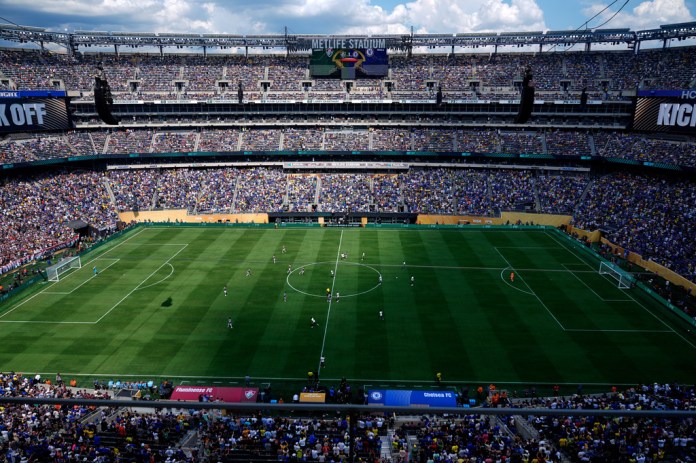
The Democratic attorneys general of New York and New Jersey subpoenaed FIFA on Wednesday over high ticket prices for the World Cup and reports of soccer fans not receiving the seats for which they paid. New York’s Letitia James and New Jersey’s Jennifer Davenport are leading the investigation. FIFA is preparing for eight World Cup […]
Pope Leo XIII issued a papal encyclical in 1891 titled "Rerum Novarum," which the Vatican notes "became the document inspiring Christian activity in the social sphere and the point of reference for this activity."In that groundbreaking document about the just ordering of society, Leo XIII applied Catholic doctrines to the modern conditions that manifested as a result of the Industrial Revolution.Besides rejecting socialism as a means of remedying social ills and setting the stage for localism, the late pope expounded on the Church's doctrine on work, private property, the rights of workers, the obligations of the rich, the dignity of the poor, and other timely terms and issues.'It can only bring about conflict more quickly and render it more impersonal.'The current pope, Leo XIV, has set out in his first encyclical, "Magnifica Humanitas," to do for his era what his predecessor did 135 years ago.The Roman pontiff has, accordingly, scrutinized "the great trends of our time, particularly technological advances," through the lens of the Church’s Scripture- and tradition-based social doctrine — that living "legacy of wisdom, where we find principles for thought, criteria for discernment and judgment, and concrete guidelines for action."While the pope covers a great deal of ground in his encyclical, five remarks stand out as especially provocative and/or memorable.1. The two citiesAt the outset, Pope Leo XIV raises the questions of where man is going and toward which goal does he wish to orient himself.Leo XIV notes that in the era of AI, mankind is faced with a choice — not whether or not to embrace technology, which he does not regard as a force intrinsically antagonistic to humanity — but of whether to "construct a new Tower of Babel or to build the city in which God and humanity dwell together."RELATED: It’s not easy being pope — Leo's big new tech encyclical proves it Alessandra Benedetti - Corbis/Corbis/Getty ImagesThe American pope suggested that the choice will inevitably dictate how the transformative technology of the age is employed, given that this technology takes on the "characteristics of those who devise, finance, regulate, and use it."Following in the footsteps of Nimrod and choosing the first option would mean giving way to an ancient temptation and pursuing "a single language, a single technology, a single direction"; building a society "on pride and the claim to self-sufficiency"; and working toward a "future that excludes God and reduces the other to a means."The second option would not similarly mean dominating the heavens but rather patiently cultivating a "space in which humanity rediscovers its solid foundations and its final end" — a place "less visible and less spectacular" that is founded on the common good and has for its bedrock a firm relationship with the Almighty.Building for the common good necessitates resisting the "Babel syndrome" that animates transhumanism and other vainglorious efforts to correct what God has created and instead "accepting the limits and weakness of humanity without considering them an error to be corrected," said the pope.2. Falling victim to achievementLeo XIV observed that within the ascendant technocratic paradigm previously denounced by Pope Francis, there is a "tendency to let the logic of efficiency, control, and profit alone shape personal, social, and economic decisions."'Speed and efficiency should never be the supreme motivating force for the irreversible decisions.'This contagious way of looking at the world — which threatens to reduce "creation to an object of exploitation and human beings to mere cogs in a system driven toward ever greater efficiency" — has spread in concert with "the expansion of artificial intelligence, cognitive science, nanotechnology, robotics, and biotechnology," said the pope.Pope Leo XIV warns that unless technological progress advances with corresponding ethical and social progress, "the result may be an increase in means without a growth in humanity: 'having more' without 'being more.'"3. More dehumanization on the battlefieldSensitive to the increasing ease of war-making, "tragically marginal" efforts to prevent conflicts, and the "perpetuation of conflict as a source of power and income," the pope discussed the need to rein in and regulate the use of AI where the battlefield is concerned.Leo XIV noted that moral judgments of a lethal or irreversible nature cannot be reduced to calculation and should not be entrusted to artificial systems.RELATED: Killer drones have conquered the skies. Can we ever be safe again?
President Donald Trump said on Wednesday that he will likely attend the New York Knicks’ NBA Finals game next week. Trump, a New York native, said he was invited by James Dolan, who owns the Knicks, the New York Rangers, and Madison Square Garden to attend the game. “They really, they have some great players,” […]