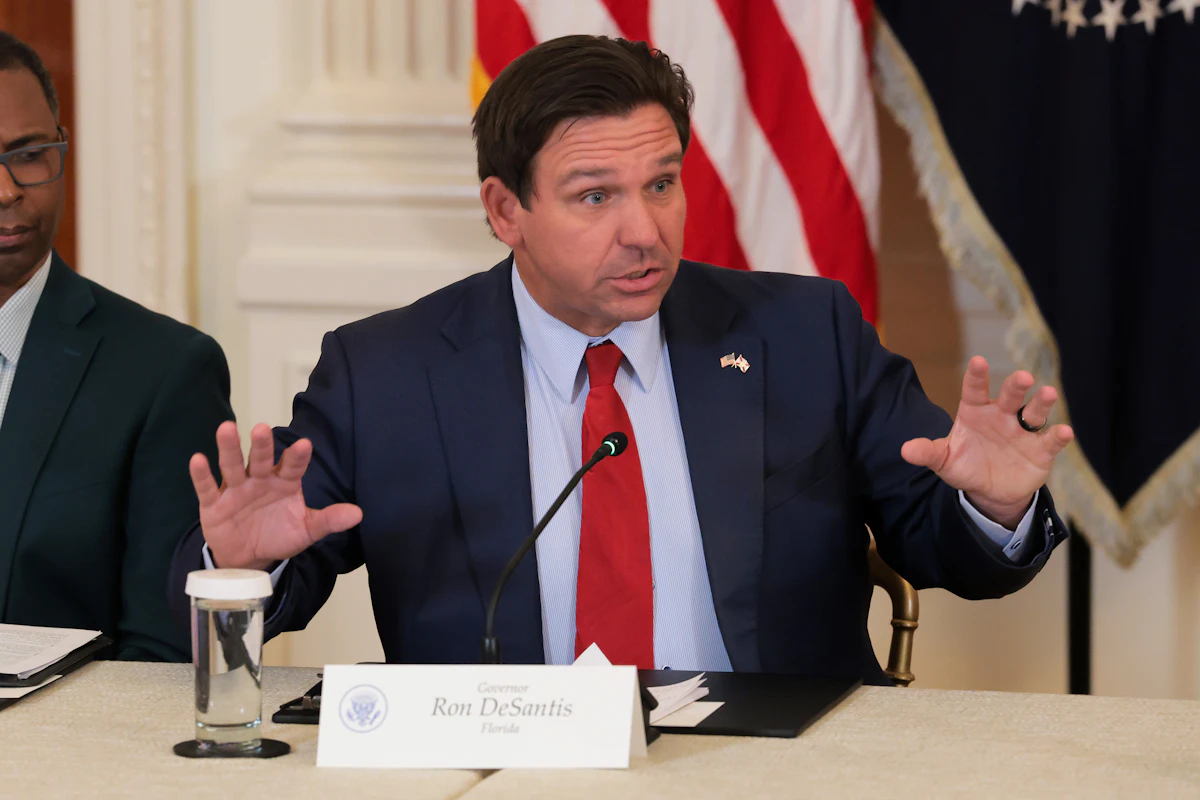
The DeSantis Gerrymander Shows the Wisdom of Virginia Democrats
Source: The New Republic · Bias: Left
Summary
Florida Republican Governor Ron DeSantis this week is pushing his state’s GOP-dominated legislature to adopt a gerrymandering scheme that could create four new Republican U.S. House districts in the Sunshine State. If this proposal passes, it would essentially cancel out the four seats that Democrats are favored to gain after the passage of a redistricting ballot referendum in Virginia last week. So was the Virginia effort a waste? Did it encourage Republicans to do more gerrymandering? No and no. The reality is, no matter what Democrats do, President Trump and Republicans in this era are always breaking with traditional democratic norms and values to win and hold power. They were destined to gerrymander Florida, no matter what happened in Virginia. By acting in Virginia, Democrats at least minimized the damage from the redistricting process and clearly showed that the party won’t just concede on this issue to Republicans. In considering Florida’s and Virginia’s actions, it’s worth remembering the recent history of gerrymandering in the United States. During the 2010s, Republicans aggressively gerrymandered, ensuring that states such as North Carolina and Wisconsin, which have about equal numbers of Democratic and Republican voters, had huge GOP majorities in their state legislatures and U.S. House delegations. Meanwhile, many blue and purple states were turning redistricting over to independent commissions to ensure fair maps. During President Biden’s first two years in office, congressional Democrats tried to pass a national pro-democracy bill that would have required all 50 states to adopt independent redistricting commissions. Congressional Republicans, along with then–Democratic Senators Joe Manchin and Kyrsten Sinema, blocked that provision. Then last summer, Trump implored Texas and other GOP-controlled states to rejigger their districts outside of the traditional once-every-10-years process. In short, Democrats want to end gerrymandering. Republicans love it. Mainstream media coverage of these redistricting battles largely ignores those realities, because many news outlets prioritize not seeming biased against Republicans over accurate coverage of American politics. And of course, gerrymandering isn’t the only hyperpartisan, democracy-eroding tactic that Republicans have employed in recent years. They blocked a Democratic Supreme Court nomination (Merrick Garland), claiming it was too close to the next presidential election, but then approved a Republican nomination (Amy Coney Barrett) even closer to Election Day four years later. They filed numerous baseless lawsuits to question the results of the 2020 presidential election, then held an insurrection to try to stop Joe Biden from being declared the winner. They are seizing ballots and other election materials across the country to justify unfounded accusations of voter fraud. The conservatives on the U.S. Supreme Court are freeing the Trump administration from following existing law, after constantly striking down executive actions taken by Presidents Obama and Biden.Considering this history, it is hard to imagine Republicans would have forgone gerrymandering in Florida if Democrats had held back in California and Virginia. They are not engaged in tit for tat—it’s all tit. Today’s Republicans do not believe in neutral political processes, in which they can lose power or control. They wanted to redraw districts in Texas and other states last year because they feared losing the House. Trump is even more unpopular now, so the potential of Republicans losing the House is even higher. As someone who believes in democracy, I don’t think that a political party that governs in an unpopular way and therefore is opposed by the majority of voters should get to keep control of a legislative chamber by redrawing the districts unfairly. Today’s Republican Party would have been just fine with such an outcome, though, because the party doesn’t fully believe in democracy. Republicans even gerrymander in the most undemocratic way possible. Virginia Democrats presented their new maps long before the state legislature voted, allowing Republicans and nonpartisan observers to scrutinize the process. In contrast, DeSantis and his team drew the new districts with little input from the public and state legislators (reportedly showing them to Fox News before fellow Florida Republicans) and are trying to push them through only a few days after they were released. If Florida Republicans back DeSantis’s new maps, the party will have redrawn 13 U.S. House districts nationwide in its favor since the 2024 elections. That’s a huge number. Experts considered only around 60 House seats as truly up for grabs. Right now, just five seats separate the two parties. (Republicans are at 217 in the House, Democrats 212.) But in the redistricting fight, so far it’s 13–10, not 13–0. Thank God.
Related Coverage
- Billionaire Tech Mogul Peter Thiel Warns Woke AI Company Anthropic Could Rig 2028 Election for Democrats (Far Right — The Gateway Pundit)
- Newly released footage shows Florida deputy responding to fatal alligator attack (Far Right — BizPac Review)
- Gov. Wes Moore on ‘responsibility’ to show ‘patriotism is not political’ (Center Left — NBC News Politics)
- Bannon warns the ‘old politics are gone’ amid Democrat socialist surge (Far Right — BizPac Review)
- Wes Moore on democratic socialist gains: Voters want ‘someone who is going to fight for them’ (Center — The Hill News)
- Karoline Leavitt on the ‘Full Blown Communist Revolution’ Happening Thanks to Democrats (Video) (Far Right — The Gateway Pundit)
- The Democrat Party Is Literally Communist, and the Voters Admit It! (VIDEO) (Far Right — The Gateway Pundit)
- Vance: Rep. Ocasio-Cortez will lead Democrat presidential race in 2028 (Far Right — One America News Network)
Daily Analysis
Read the full Parallax Pulse for April 29, 2026 — an AI-powered analysis of how Left and Right media covered the biggest stories this day.
More Headlines From April 29, 2026
- Trump hosts King Charles at White House State Dinner (Center)
- Secret Service director: Agents did ‘great job’ in WHCA dinner shooting response (Center)
- Gunshot at dinner may have struck officer's phone in pocket of bulletproof vest (Center)
- Chuck Todd whines that Trump does not care about the safety of anyone in his orbit (Far Right)
- Iran war has cost the U.S. $25 billion so far, Pentagon official says (Center Left)