Following Phone Call with Arab Allies, Turkey and Pakistan, President Trump Notes Memorandum of Understanding with Iran to Be Announced Shortly
Far Right
The Gulf Arab allies had been negotiating through Pakistan with Iran. Egypt, Jordan, Bahrain, Saudi Arabia and Qatar are now joined by Turkey in the construction of the agreement, which is important because Turkey now represents the figurative center of the Muslim Brotherhood. The GCC and President Trump are not going to end Iranian Islamic […]
The post Following Phone Call with Arab Allies, Turkey and Pakistan, President Trump Notes Memorandum of Understanding with Iran to Be Announced Shortly appeared first on The Last Refuge.
US Secretary of State Marco Rubio said there may be “some good news” regarding the blocked Strait of Hormuz in the coming hours, as Iran and Washington press ahead with peace negotiations.
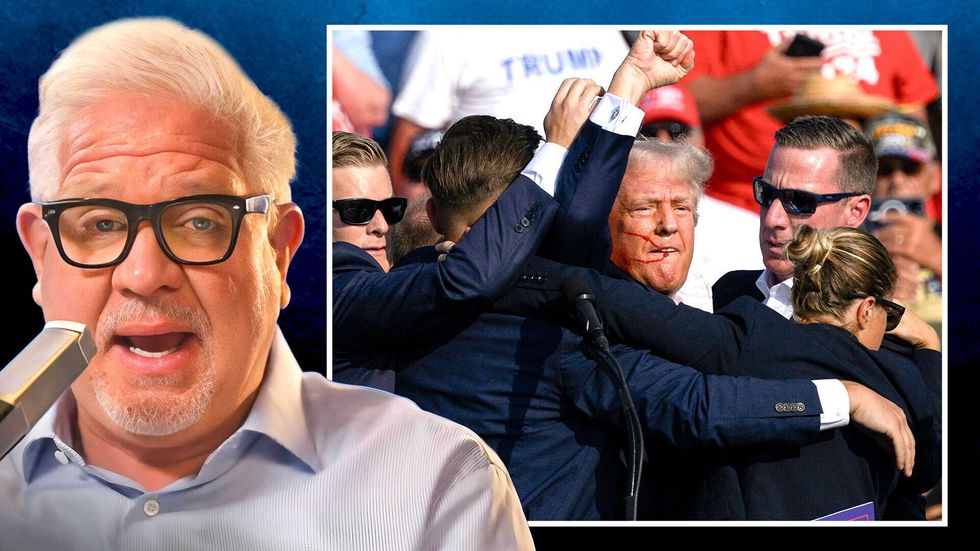
In the past, assassination attempts against a president were fairly simple, Glenn Beck says.“It looked like one guy, one gun.”But those days, he argues, are “absolutely gone.”Today, assassination attempts — especially those against President Trump — look “really different.”On this episode of “The Glenn Beck program,” Glenn exposes a terrifying pattern behind the numerous attempts on Donald Trump’s life. The first attempt to assassinate Trump occurred in 2016 at a rally in Las Vegas when a young man tried to grab a police officer’s gun with the stated intention of shooting and killing Trump.“That’s the old model,” Glenn says.But in 2017, things began to take a darker turn.In September of that year, during President Trump’s visit to a refinery in Mandan, North Dakota, a man stole a forklift and tried to enter the presidential motorcade route with the intent to flip Trump’s limousine and kill him.“To me, this is the difference between planting a bomb in the basement of the World Trade Center and then that not working, and then trying to fly airplanes into the side of the building five years later,” Glenn says, highlighting the growing desire for “spectacle.”In 2020, things progressed again when a Canadian woman mailed a letter containing homemade ricin (a highly toxic poison) addressed to then-President Trump at the White House.“Distance now is entering the picture,” Glenn says. “You don’t need access; you just need to find a way to get proximity.”Then came the closest attempt in 2024, when at a campaign rally in Butler, Pennsylvania, 20-year-old Thomas Matthew Crooks opened fire from a rooftop with an AR-15-style rifle, grazing President Trump in the ear.“This is no longer chaotic. This is ... well-planned and calculated,” Glenn says, drawing attention to all the “warnings” leading up to Crooks’ attempt, most notably the numerous sightings of Crooks on a strangely unguarded rooftop.Two months later at Trump International Golf Club in West Palm Beach, Florida, 58-year-old Ryan Wesley Routh hid in bushes along the course with an AK-47-style rifle and a scope, lying in wait to shoot President Trump while he was golfing, but was spotted by Secret Service agents before Trump arrived at that hole.“This is not anger anymore. Now they’re stalking him,” Glenn says.“Behind the scenes, federal prosecutors uncover a plot tied to individuals linked to the Iranian Revolutionary Guard. ... Not just Trump, but several U.S. leaders are targeted,” he continues. “Now, that’s a different category. ... That’s geopolitical; that’s foreign terrorism.”And finally, the latest attempt on President Trump’s life occurred just last month when armed gunman Cole Tomas Allen allegedly tried to storm the security perimeter at the Washington Hilton where President Trump was hosting the White House Correspondents’ Dinner. He allegedly fired multiple shots in an attempt to kill Trump and other Cabinet officials, but Secret Service tackled and arrested him, preventing any casualties.“I want you to think about the target. It’s not a rally; it’s not a golf course. It’s a room full of the leadership of the United States,” Glenn says. “That’s not an assassination. That’s destabilization. ... That is the constitutional order being disrupted.”Why have these assassination attempts become more organized and common?Glenn answers that question by recapping three stories just from this month:During a CNN interview, Democratic U.S. Senate candidate Mallory McMorrow (Mich.) drew parallels between Nazi Germany and what’s happening under the Trump administration, citing an “authoritarian slide.” Democratic U.S. Senate candidate Raymond Chandler (Penn.) was arrested after allegedly leaving voicemails threatening to slit the throats of a Republican congressman and his young daughter, and making threats against President Trump.Mohamed Abdou, a former Columbia University professor who was fired in 2024 after publicly praising Hamas, Hezbollah, and the October 7 attacks, spoke at Virginia Tech as part of his “Death to the Akademy” tour. During the event, he openly declared support for Hamas/“Palestinian resistance”and explained the slogan “Death to America” as meaning a total end to the U.S. empire and the destruction of America as a “settler-colonial” project.“What’s happening here, America? What’s changed?” Glenn asks.“Everything,” he answers.“It used to be one guy walking in behind President Lincoln and shooting him. ... Now it’s layered. You have the lone actors; you also have the ideological extremists; you have the distance attacks, the mail, the surveillance, the infiltration,” he explains.“But you also have something else. You have the failure points; you have the security gaps; you have the missed warnings; you have systems that don’t seem to be adapting, or at least not fast enough.
Meet the Press Moderator Kristen Welker joins Hallie Jackson on Sunday TODAY to discuss Republicans raising concern over what’s included in President Donald Trump’s potential peace deal with Iran. "Really witnessing an extraordinary week of divisions between the president and his own party, all raising questions for Republicans about his priorities as we get deeper into this midterm election cycle,” Kristen says.
Sen. Thom Tillis (R-N.C.) on Sunday added his voice to other Republicans criticizing an emerging peace deal with Iran, saying he would not support it based on his understanding of what it includes. “It doesn’t make sense to me,” Tillis said of the deal, arguing it was a mistake to leave nuclear material in Iran.…
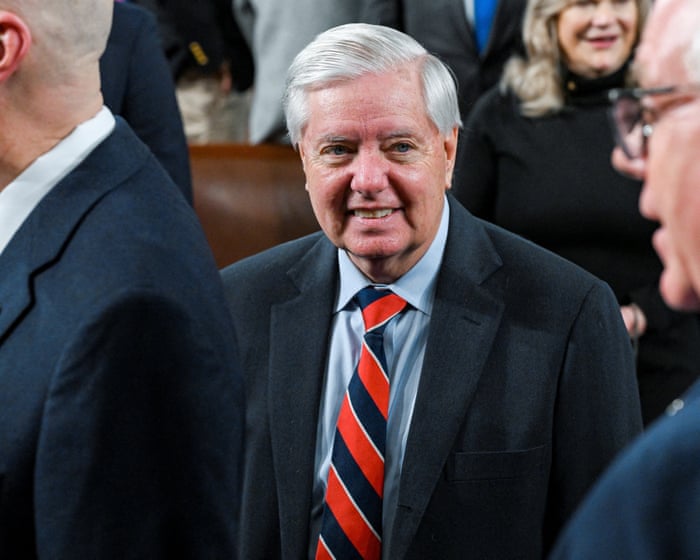
Trump insists US won’t rush talks with Tehran after rebukes from Republicans, including Ted Cruz and Lindsey GrahamRepublican hawks have issued a rare rebuke of Donald Trump over his planned peace deal with Iran, describing it as a “disaster” and questioning why the US president launched the war in the first place.Allies of Trump who strongly backed his controversial decision to order war on Iran alongside Israel urged him to “hold the line” this weekend, despite mounting economic costs and no sign of progress on many of the the initial objectives set out by his administration. Continue reading...
Donald Trump took to Truth Social Sunday morning to praise what he called a "much more professional and productive" relationship with Iran — the same country he spent years branding the world's leading state sponsor of terrorism."Our relationship with Iran is becoming a much more professional and productive one," Trump wrote, describing ongoing nuclear negotiations as proceeding in "an orderly and constructive manner."The statement landed with considerable whiplash for anyone who followed Trump's career. In 2018, Trump withdrew from the Obama-era nuclear deal and launched a "maximum pressure" campaign of crushing economic sanctions against Tehran. In January 2020, he ordered the assassination of Iranian General Qasem Soleimani, the head of the Islamic Revolutionary Guard Corps' Quds Force, in a drone strike at Baghdad's international airport — an act that brought the two countries to the brink of open war.Now, in his second term, Trump finds himself in the position of negotiating his own nuclear deal with the same government — and praising the relationship in terms his predecessor might have used.The post also contained a swipe at Barack Obama — using his full middle name, a longtime Trump dog whistle — calling the 2015 Joint Comprehensive Plan of Action "one of the worst deals ever made by our Country" and "a direct path to Iran developing a Nuclear Weapon."But in the very same post, Trump described his own negotiations in terms nearly identical to what Obama-era diplomats might have said: both sides taking their time, getting it right, no rushing, proceeding carefully toward a verifiable agreement.The contradiction did not go unnoticed. Earlier Sunday, former Secretary of State Mike Pompeo — Trump's own top diplomat during his first term — warned that the deal being floated "seems straight out of the Wendy Sherman-Robert Malley-Ben Rhodes playbook," referring to key architects of Obama's Iran deal. White House communications director Steven Cheung responded by telling Pompeo to "shut his stupid mouth."Trump closed his post with a notable flourish, suggesting that Iran might one day consider joining the Abraham Accords — the normalization agreements between Israel and several Arab states that Trump brokered in his first term.
A senior House Democrat predicted this weekend that Republican members of Congress will increasingly distance themselves from Donald Trump once they return home during recess and face their constituents — and he says the signs are already there."I think that as Republicans come back home after this recess and hear from their constituents, and as they get past their primaries, more and more will start to break away from Trump and some of his draconian and criminal behavior," Rep. Greg Meeks (D-NY), the ranking member of the House Foreign Affairs Committee, told MS NOW on Saturday.Meeks pointed to the growing revolt in the Senate over Trump's $1.8 billion slush fund — money that could flow to supporters convicted in connection with the January 6th Capitol attack — as an early sign of the fractures to come. Republican senators, he said, were "absolutely right" to call it a nonstarter."You heard these Republican senators and they were absolutely right — this is ridiculous, this is terrible," Meeks said. "Some are retiring and don't have to pay homage to him, others who he has double crossed. And so they seem to be wanting to stand up for what they know is disastrous."Meeks drew a sharp distinction between the Senate and the House, where he sees far less independence. "I can't depend upon the House, because the members of the House — they will do whatever Trump says." But he suggested even that could change as political conditions shift.As evidence that the Republican base is not as monolithic as Trump's primary victories suggest, Meeks argued that Trump's hold is essentially on about 30 percent of the electorate — primary voters — not the broader public that will decide general elections."That's 30% of the individuals," he said. "These are not the individuals that would be able to vote in a general election."The congressman said the pattern — of Republican members privately opposing Trump while leadership runs interference — will become harder to sustain as midterms approach and members face voters directly."It's time for some of the Republicans to stand up and do the right thing by the American people," Meeks said, citing $5 gas prices, rising grocery costs, and health care as the kitchen-table issues driving discontent in districts across the country.
Following Phone Call with Arab Allies, Turkey and Pakistan, President Trump Notes Memorandum of Understanding with Iran to Be Announced Shortly | ParallaxNews.io