As antisemitism rises across the United States, many Jewish Americans are no longer simply asking where extremists stand. They are asking where America’s political leadership stands. That frustration is no longer confined to private conversations inside Jewish communities. It is increasingly becoming part of a public debate as synagogue protests, anti-Israel demonstrations, online radicalization, and […]
When outgoing Sen. Thom Tillis (R-North Carolina) decided not to seek reelection in the 2026 midterms, he likely avoided the fate that Rep. Thomas Massie (R-Kentucky), Sen. Bill Cassidy (R-Louisiana) and at least five Indiana state lawmakers recently suffered when they were voted out of office via GOP primaries. Trump was angry with Massie, Cassidy and the others, railing against them relentlessly and endorsing MAGA primary challengers — and Massie realized he was in danger as well. But Tillis plans to serve out the rest of his term, and he candidly spoke his mind about the Trump administration and the state of the Republican Party during an interview with Politico's Jordain Carney.Although the conservative senator isn't a full-fledged Never Trumper, he hasn't been shy about criticizing the president at times. And he attacked a variety of Trump administration and MAGA policies during the interview, giving fellow Republicans what Carney described as "a dose of bitter medicine." "Every time I've disagreed with the president," Tillis told Politico, "it's been almost exclusively because I think it's divergent from Republicans' interest in getting reelected this November. Every single time. The health care policy that got airdropped in the 'big beautiful bill,' I knew it was going to be a problem. It is a problem now. Now, everybody sees that. That's why I objected to the reconciliation last year. The reason I'm objecting to the ballroom and the slush fund for the DOJ — bad politics, really bad timing, bad policy. I mean, that's the trifecta. Every time I have opposed this president is because I believe it's at odds with getting Republicans reelected."Tillis offered a scathing critique of Pete Hegseth's performance as defense secretary, once again calling for him to be fired.Tillis told Politico, "I suspect that Hegseth cast aside concerns he was hearing from some of the finest people that ever served in uniform and took his cowboy-ish approach to going into Iran. I'm glad the president did what he did in Iran; I'm not glad that he has Hegseth advising him on the details…. I'd love to see Pete Hegseth fired because he's incompetent and doing a horrible job."During the interview, Tillis criticized Trump's "anti-weaponization fund" as "an embarrassment" — calling for Congress to "nuke it." And he was highly critical of U.S. Department of Justice (DOJ) investigations of outgoing U.S. Federal Reserve Chairman Jerome Powell and others.Tillis told Politico, "I’m thinking about the picture that right now is the only basis I have for a new indictment against (former FBI Director) Comey. Some of the other bogus lawsuits from now no-longer-acting acting U.S. attorneys. All that, I want to know whose fingerprints were on it. I don't think big DOJ knew about the Powell investigation, so I wouldn't hold that against them; that was a boneheaded move in the bowels of DOJ. But anything where they were in the decision loop, yeah, they got a lot of questions to answer to get my support."
Another corruption scandal has erupted inside the federal contracting world.
The post Two Shady Defense Contractors Busted in Massive Bribery and Fraud Scheme That Ripped Off Taxpayers and Corrupted Critical U.S. Military Tech Innovation Contracts appeared first on The Gateway Pundit.
Republicans are going all out to convince the American people that President Trump’s $1.8 billion taxpayer-funded slush fund for his MAGA allies is actually a good thing.Representative James Comer proclaimed that there’s a “need” for the slush fund.“The things they tried to convict him of—it was a joke,” he said Friday. “So I think that there is a need for it. What the president needs to do to be able to get this through is to explain it and have a plan.”Representative Ralph Norman appeared to have no problems with paying those convicted of assaulting police officers, saying Thursday that “January 6 is an issue that was made up in the first place” and a “staged thing from day one.”Representative Jody Arrington called Trump “one of the biggest victims of weaponization” and argued that the slush fund is “an appropriate use of tax dollars.” Representative Dan Meuser went as far as to call the slush fund “reparations to those who were wronged by Biden.”Even House Majority Whip Tom Emmer, the third-highest-ranking Republican in the House, defended the slush fund.“Having your own personal lawyer, at this point, become [attorney general]—AG is the only person who could’ve gotten rid of these audits, right?” CNBC’s Joe Kernen asked Emmer, referring to acting Attorney General Todd Blanche’s related settlement agreement that the IRS cease all audits of President Trump and his family. “It just looks … smells bad.”“Joe, I think it’s unfair to say it’s just the president who’s upset. Americans are upset. They don’t wanna see their government be used against anyone, Donald Trump or anybody else,” Emmer replied, not engaging with Kernen’s actual point. “It was so egregious what they did to Donald Trump and his family. It’s one of the reasons that he’s back in the office. America wants this cleaned up, and Donald Trump is gonna make sure it is.”KERNEN: The AG is the only person that could've gotten rid of these audits, and it was Trump's personal lawyer. It just smells bad.EMMER: It was so egregious what they did to Donald Trump and his family -- it's one of the reasons he's back in the office. America wants this… pic.twitter.com/JmiQW4RJOA— Aaron Rupar (@atrupar) May 22, 2026Emmer is really arguing that the majority of Americans want their taxes to go towards a slush fund for MAGA sycophants, January 6 rioters, and any other individual or group that felt “targeted” by the Biden administration. He continued pushing this narrative later in the interview.“So we’re all clear, you support the settlement that the president made with—some people would say he made with himself, others would say it was with the AG—you’re supportive of that, you feel like that was totally on the up and up?” Andrew Ross Sorkin asked Emmer.“Let’s see what it is when it comes over to the House. The Senate’s gotta get their work done, Andrew, and you’re asking me to pass judgment on something—”“No, no, no,” Sorkin interrupted. “The settlement unto itself. I’m not talking about the justice fund. The settlement that was made between the president and the administration.… Do you look at that and say ‘that’s totally fine,’ you support how that was done?”Emmer claimed ignorance.“Well, I wasn’t in the room, so I don’t know what the details are. But I can tell you this: No one knows weaponization of government against him and his family better than Donald Trump. He was absolutely raked by these people for years, and the American public knows it,” he concluded.Trump was “targeted” because he incited an insurrection. Now he wants you to pay his damages, and the GOP is acting as if it’s a completely reasonable thing to do—all as this widely unpopular president approaches midterm elections.
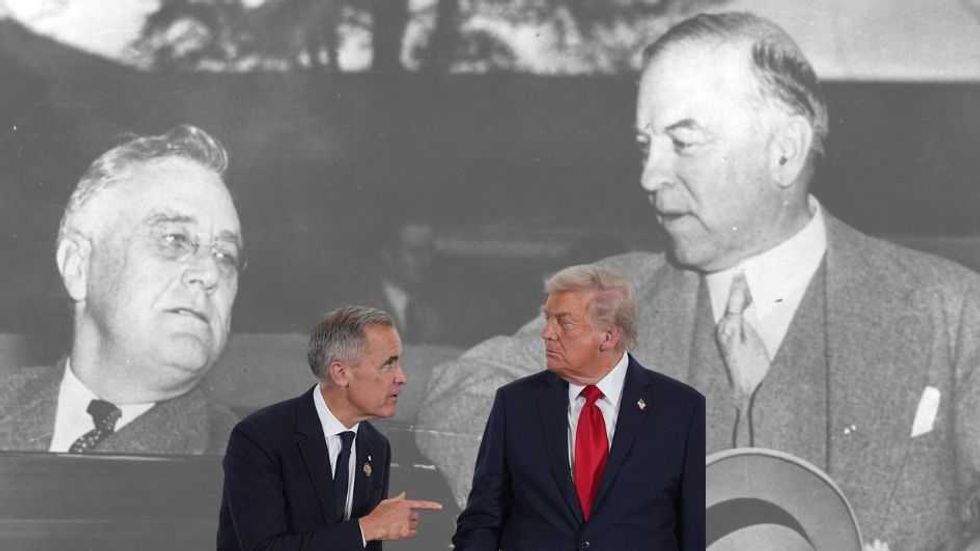
The Pentagon appears to be sending Ottawa a message: Rhetoric is no substitute for military capability.The Department of Defense announced Monday it was “pausing” the 86-year-old Permanent Joint Board on Defense between the United States and Canada, according to Undersecretary of War for Policy Elbridge Colby. The move comes amid mounting frustration in Washington over Canada’s chronic defense underinvestment — and Prime Minister Mark Carney’s increasingly confrontational rhetoric toward President Donald Trump.'We can no longer avoid the gaps between rhetoric and reality. Real powers must sustain our shared defense and security responsibilities.'Established in 1940 by President Franklin Roosevelt and Prime Minister William Lyon Mackenzie King, the board became one of the earliest pillars of continental defense cooperation. Coming as Nazi Germany tightened its grip on Europe and fears grew over Atlantic security, the agreement reflected Roosevelt’s recognition that American and Canadian security could no longer be treated separately.That alliance eventually evolved into NORAD and decades of deep military integration between the two countries.All talkNow Washington appears to be signaling that the relationship cannot continue on autopilot.“We can no longer avoid the gaps between rhetoric and reality,” Colby wrote on X. “Real powers must sustain our rhetoric with shared defense and security responsibilities.”Colby argued that while a militarily capable Canada benefits the United States, Ottawa has repeatedly failed to meet its defense commitments in a credible way. The timing is awkward for Carney, whose government has loudly projected Canadian independence from Washington while remaining vague about how it intends to rebuild the country’s depleted armed forces.RELATED: 'AMERICAN INVASION': Flailing Canada PM Mark Carney invokes historical grudge in latest lob at Trump George Rose/Anna Moneymaker/Getty ImagesJet bluesAlthough Ottawa recently claimed the government had finally reached NATO’s benchmark of spending 2% of GDP on defense, critics have questioned how the government arrived at that number. Media reports have indicated that the Liberals counted items such as landscaping at military bases and civilian airport infrastructure upgrades as defense expenditures.More tellingly, Carney’s April 28 Spring Economic Statement reportedly contained little detail on major procurement priorities.That uncertainty now extends to Canada’s planned purchase of 88 Lockheed Martin F-35 fighter jets. Despite years of delays and political debate, the Carney government is still reviewing the order, with Defense Minister David McGuinty recently confirming that alternatives remain under consideration.One possibility floated by Ottawa is a mixed fleet pairing the American-made F-35 with Sweden’s Saab Gripen fighter. But U.S. Ambassador to Canada Pete Hoekstra has repeatedly warned that Canada’s role in NORAD could be jeopardized if Ottawa fails to follow through on the full F-35 purchase.Buy or bewareThe concern is not merely political but operational. Every branch of the U.S. military that flies fighter aircraft is transitioning to the F-35 platform, which is also used by several of Canada’s closest defense partners, including the British Royal Air Force and the Royal Australian Air Force. Hoekstra has argued that the Gripen would create interoperability problems inside a continental defense structure increasingly built around the F-35 ecosystem.For Washington, the frustration is becoming increasingly obvious: Canada wants the diplomatic stature and moral authority of a serious middle power while continuing to hesitate on the military commitments required to sustain that role.The Pentagon’s decision to pause the defense board may ultimately prove symbolic. But symbols matter in alliances — especially when they come from Washington.After decades of assuming continental defense cooperation was automatic, the United States now appears willing to publicly question whether Canada is prepared to carry its share of the burden.
On Wednesday, it was revealed that the Pentagon is mere months away from running out of money for President Donald Trump’s war against Iran. According to Punchbowl News, this looming deadline has congressional Republicans “anxious” over the lack of a plan to move forward. Over the past three months, the Defense Department has been conducting operations in Iran using its annual operations and maintenance budget, which wasn’t crafted with extra money for additional large-scale missions like a war. With the conflict in the Middle East showing little sign of ending once and for all, Pentagon officials are warning that funding for the war could run out as soon as July, resulting in cutbacks in vital training and other necessities. But before Congress can consider a budget extension, the Trump administration needs to submit a funding request detailing its financial needs. No such request has come, however, and congressional patience is waning.“I’m looking forward to seeing a supplemental here soon, and I’m sure that the [Defense Department] obviously needs it and they’re working on it, so I’m anxious to get it — hopefully, like, any day now,” said Representative Ken Calvert (R-CA). The lack of a funding request isn’t the only issue. Not only is there a wide gap between what Republicans and Democrats are willing to allow, but Republicans themselves have been unable to reach an agreement. “I don’t have a deal between the administration and the legislative leadership of both chambers,” complained House Appropriations Committee Chair Tom Cole (R-OK). “I don’t have a deal between House and Senate Republicans, and I don’t have a congressional budget resolution.”GOP leaders are warning, however, that they may not be able to pass another reconciliation package, which would represent a large portion of the Pentagon’s budgetary expectations. A key obstacle, says Republicans, has been a lack of clarity on funding priorities. “There’s important stuff in it,” said Senator Lisa Murkowski (R-AK) about the reconciliation request. “Helping us understand our role here on the Appropriations Committee and how this maps forward is important.”The war on Iran isn’t the only Trump policy that has depleted the Pentagon’s coffers. According to the Wall Street Journal, the Army is facing as much as a $6 billion shortfall due to the deployment of the National Guard in Washington D.C. and at the border. And as the unpopular war drags on and the “looming defense spending train wreck” approaches, lawmakers are losing their patience. “We have to start with getting that number from the Pentagon and it needs to be here now,” declared Representative Rob Wittman (R-VA), vice chairman of the House Armed Services Committee.
Acting Attorney General Todd Blanche on Tuesday had to go on defense over the Justice Department’s new “anti-weaponization” fund, a coffer he told lawmakers would be available to Trump campaign donors and those convicted of attacking police. Blanche appeared Tuesday before a Senate Appropriations subcommittee for a previously scheduled hearing about the Justice Department’s budget…