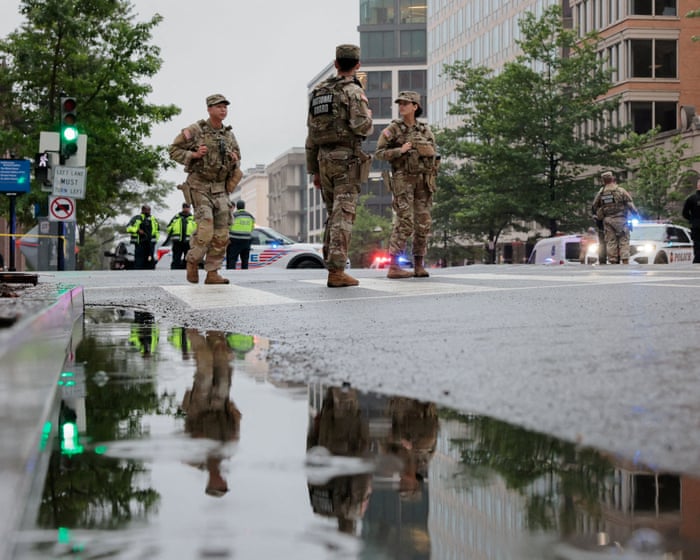
Suspect who died after exchanging fire with agents had tried to enter the complex last summer, records showA gunman who opened fire outside the White House on Saturday before he was shot by federal agents was already known to the US Secret Service, court records show.The man, 21, was taken to a nearby hospital, before he was later pronounced dead. He had previously tried to enter the complex, according to an affidavit filed in DC superior court in 2025, following an arrest nearby. Continue reading...
The Secret Service shot and killed an armed suspect who opened fire at a security checkpoint outside the White House. The 21-year-old suspect was known to police and Secret Service with a history of mental health concerns, according to multiple senior law enforcement officials. A second person, who authorities believe to be a bystander, was injured in the shooting and that person’s condition is unclear. NBC’s Julie Tsirkin reports for Sunday TODAY.
Hours after a deadly shooting incident outside the White House, President Donald Trump took to Truth Social just after midnight to thank the Secret Service and, in the same post, push for the construction of his controversial White House ballroom.In a post published shortly after 12 a.m. Eastern, Trump opened with praise for the agents who killed the gunman near the White House gates earlier in the evening. He described the suspect as a man with "a violent history and possible obsession with our Country's most cherished structure.""Thank you to our great Secret Service and Law Enforcement for the swift and professional action taken this evening against a gunman near the White House," Trump wrote.The president then pivoted to his ballroom project. Trump argued that the shooting, combined with what he called the "White House Correspondent'Dinner shooting" from a month earlier, demonstrated the need for what he has been describing as a massive new venue on the White House grounds."This event is one month removed from the White House Correspondent'Dinner shooting, and goes to show how important it is, for all future Presidents, to get, what will be, the most safe and secure space of its kind ever built in Washington, D.C.," Trump wrote, along with the prominent typo.He closed with a familiar appeal."The National Security of our Country demands it!" Trump added.The ballroom, which Trump has touted as one of his second-term priorities, has drawn criticism from lawmakers and watchdogs who view it as a vanity project and claim that the security justification is stretched well beyond its merits. Trump's overnight post Sunday morning is the latest in a pattern of using public safety incidents and high-profile news events as occasions to argue for the ballroom's necessity.
Social media is still ringing from a painful recent Fox News poll delivering some of the most damaging news President Donald Trump could probably get.The poll’s most brutal finding was that Trump is not only losing serious ground among groups he made surprising inroads with in 2024. He’s also cratering with his most loyal constituency: white men.The Fox survey revealed Trump’s approval was underwater with working-class whites (46–54), rural voters (43–57), and general white men (48–52). Other, less revelatory news, was that Trump was faltering among young voters (31–69), Latinos (33–67), and working-class voters of all races (40–60).Pollsters already knew Trump blew his 2024 gains with nonwhite working people for months, but the plummeting approval among white constituents was the final blow among social media critics.“Traitor Trump is toast. He is underwater with everybody. Only the most brainwashed of cultists still approve of what he is doing,” wrote one X account that sounds nothing like the MAGA message the owner has been posting since 2023.Other accounts claiming to be “conservative” also blasted Trump’s latest loss, with one X user posting: “The old folk is his only core block left that doesn’t see the sham he’s running. The ‘trust the plan’ crowd and Fox News crowd are by far my favorite groups. Hilarious people.”Other accounts quickly acknowledged the brewing disaster for Trump and the Republican Party in the November midterms. “Disastrous stuff here. This doesn’t make these voters vote blue, but if enough of them stay home, that is a big problem,” said the critic.Many other MAGA posters immediately dismissed the results as fake news, despite the poll coming from Fox News. “These bum pollsters can release as many of these push polls as they want, it won't make them any more true,” said one heckler, mirroring the claims of others.Trump’s grip on U.S. white men is legendary in that he managed to harness white grievance against social safety net programs and inclusivity and use it to win the 2024 election, with the help of the belief that he could do a better job on the economy than his Democratic predecessor. But Trump’s numbers on the economy are even worse, with only 29 percent of voters approving of his handling of it, while a brutal 71 percent disapprove. On inflation the voting public has a 76-to-24 disapproval — with all core voter groups disapproving of Trump’s economic performance in huge majorities.Wilmington College adjunct professor Keith Orejel, after seeing Trump’s historic collapse among white voters, said Trump gave Democrat a unique opportunity to dominate D.C. politics, if only they had the will to take it.“If you ask a lot of normie Dems they would say this group is unreachable and governed by nothing but culture wars. And yet here we are, -8 because Trump tanked the economy,” Orejel posted on X.
The White House doesn't expect an agreement to end the war with Iran Sunday and thinks it could take several days for the deal's approval by Iran's leadership, including Supreme Leader Mojtaba Khamenei, a senior U.S. official said in a briefing with reporters. Why it matters: While U.S. officials are optimistic that a deal will be signed within days, they also acknowledge it has not been finalized and could still fall apart. "We are in a very good place — but there are ways in which the deal can be undermined," a senior U.S. official said.The deal would avoid an escalation of the war and decrease the pressure on the global oil supply. However, it's unclear whether it will lead to a lasting peace agreement that also addresses President Trump's nuclear demands.President Trump told his "representatives not to rush into a deal" with Iran, he announced Sunday on Truth Social, saying "both sides must take their time and get it right."He said the U.S. naval blockade will "remain in full force and effect until an agreement is reached, certified, and signed."State of play: The senior Trump administration official said there are still details "to work out," but the "slow and opaque" nature of Iran's decision-making system could delay an agreement by another few days."There is still back and forth on specific details. Some words we care about, Some words they care about," the U.S. official said."Our understanding is that the Supreme Leader, Mojtaba Khamenei, has endorsed the broad template of the deal. Whether this becomes an agreement is still an open question," the official added. The other side: Iran's state media on Sunday accused the U.S. of "creating obstacles" in the negotiations. Iranian President Masoud Pezeshkian said on Sunday that Iran is "ready to reassure the world that we are not seeking nuclear weapons" but stressed negotiators "will not compromise when it comes to our country's honor and dignity."Zoom in: The U.S. official said the draft agreement opens up the Strait of Hormuz in exchange for the U.S. lifting its naval blockade. While the strait opens and the global economy gets "breathing room," the parties would negotiate limitations on Iran's nuclear program. As part of the deal, the Iranians "will agree in principle to dispose" of their enriched uranium stockpile, and the parties will discuss how to do it. "Nobody disputes that the stockpile will be disposed of. The question is how," the official said.The Trump administration wants the final deal to cover all of Iran's roughly 2,000 kilograms of enriched uranium, not just the 450 kilograms enriched to near-weapons-grade levels. "It will all be part of the discussion," the official said. As part of the draft agreement, Iran has committed to discussing a moratorium on uranium enrichment, but the parties still need to negotiate how long this moratorium will last."We want to see a substantial commitment to forgo enrichment. We think we will get it. We feel good about where we are on the broad commitments regarding the enrichment issue," the U.S. official said.What to watch: The principle driving the deal is that the more Iran concedes on enrichment and nuclear material, the more sanctions relief it receives, the U.S. official said."No dust, no dollars. If no highly enriched uranium is given [up], they will get no relief," the U.S. official said. "The more they do, the more they get. There will be no immediate unfreezing of funds."Between the lines: The main difficulty on enrichment and nuclear material has to do with Iranian "national pride considerations" and how the Iranians "sell it" domestically, the official said.The intrigue: Some Republican senators and conservative commentators close to Trump have criticized the emerging deal, with some comparing it to the 2015 nuclear deal signed by President Obama.In his Truth Social post, Trump pushed back and called the Obama-era nuclear deal "one of the worst deals ever made." He said his current negotiations with Iran are "THE EXACT OPPOSITE."Behind the scenes: Israeli Prime Minister Benjamin Netanyahu and his team have been involved in the process of negotiations, the U.S. official said. "We don't want them to be blindsided. The coordination has been quite close." But Israeli officials tell Axios that Netanyahu is deeply concerned about the emerging deal and skeptical Iran's supreme leader will approve it.In their phone call Saturday, Netanyahu told Trump that Israel will "preserve its freedom of action against threats on all fronts, including Lebanon," an Israeli official said.Netanyahu said later in a statement that Trump "reaffirmed Israel's right to defend itself against threats on every front, including Lebanon.""We agreed that any final agreement with Iran must eliminate the nuclear danger … dismantling Iran's nuclear enrichment sites and removing its enriched nuclear material from its territory," Netanyahu said.