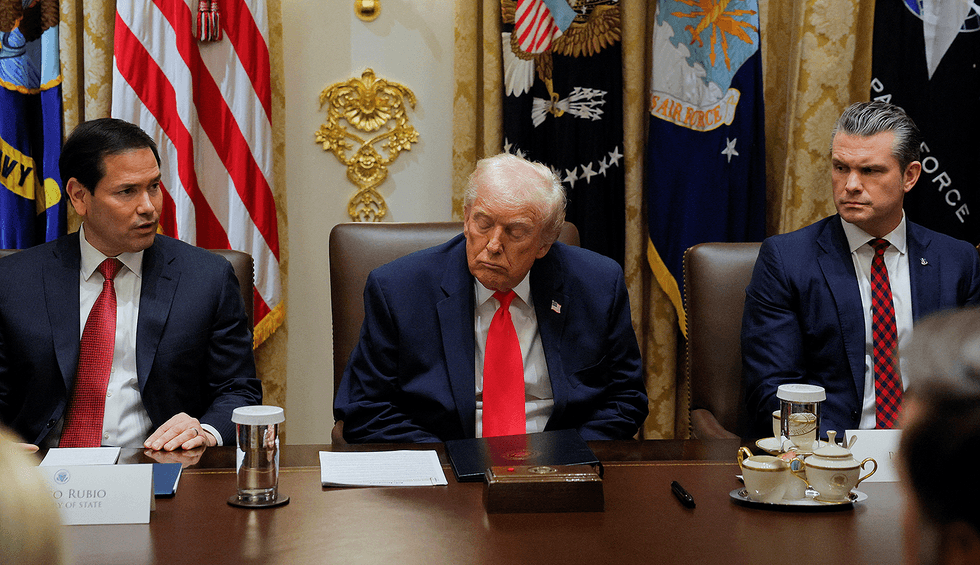
A conservative commentator and one of America’s top psychiatrists agree that President Donald Trump’s recent interview with NBC News’ Kristen Welker raises serious concerns about his mental fitness.Jonathan V. Last, a conservative commentator for The Bulwark, noted that Trump is turning 80 next week, frequently falls asleep in public and has consistent physical symptoms of decline including severe bruising on both hands, swollen legs and a neck rash. After adding that Trump’s physicians consistently misrepresent his health and therefore cannot be trusted, Last analyzed three statements Trump made to Welker that he viewed as alarming.First, when Trump was asked if America is at war with Iran, the president replied by saying “Well, they’ve been largely decapitated. And I call it a military exercise because people would rather have it called that. It’s not a big war for us. It’s not. We have the most powerful military in the world. I built it, frankly. I built it in my first four years. And I’m using it a little bit in my second four years.”He added, “Their navy is gone. Their air force is gone. Their anti-aircraft is gone. They might’ve built it up a little bit over the last four weeks during this little ceasefire that we did at the request of some very good people, very, very fine people from — actually from numerous places, as you know. You know, there are a lot of people involved. But from Pakistan in particular, the field marshal and the prime minister. And we’re very close to having a deal. And if we don’t have a deal, we’ll do it one way or the other. Either way, we win.”Last observed that, while it is obvious that Trump avoided answering the question directly, he also seemed to struggle to make any kind of coherent point.According to Last, Trump “wants to say that we’re not at war; that there’s still a ceasefire in place; and that it was the leadership of Pakistan who requested the ceasefire. But he can’t find those words, so his mind vamps about the size of the ceasefire, and the ‘very fine people’ who wanted it from ‘numerous places’ until the word ‘Pakistan’ drops into place for him.”Psychiatrist Dr. Henry Abraham, formerly of Tufts University, has repeatedly raised the alarm about Trump’s declining mental state, even writing a public letter to Trump’s doctor last month. When AlterNet shared both Trump’s answer and Last’s analysis with Abraham, he offered a different take than Last as to what it represents — although he also shared Last’s concern that Trump is unfit to be president.“Sadly, I don't want to take steam out of your argument here, but everything he's saying makes sense from his point of view,” Abraham told AlterNet. “His point of view is distorted, erroneous, grandiose, and self-serving — but that's who he is. That's not necessarily an abnormal mental status exam beyond the typical and longstanding grandiosity and self-importance that he injects into every discussion.”Last also drew attention to Trump answering a Welker question about the new Supreme Leader of Iran, claiming that the president seemed unable to remember the leader’s name “Mojtaba Khamenei.”“Well, I don’t want to go into names,” Trump told Welker when asked who is leading Iran. “But you know who they are. They’re leaders. They’re respected, respected by the people that have to respect them. They are calling the shots. We know that because we see it through various tests that we’ve given. It’s a little bit strange because you have leaders that have been there for a long time, and they get wiped out. Then you have leaders that you also know, the second tier, and they get wiped out. All of a sudden, we’re dealing with different people.”When Welker tried to give Trump a hint by referring to Mojtaba Khamenei as the son of the previous Supreme Leader, Trump merely said “he’s a part of it” before digressing further about how the Iranian people “pay homage” to their leader. Welker also asked Trump if he knows Khamenei’s current physical whereabouts or health, and Trump replied “I don’t want to say whether or not I know where he is. But there’s a good probability that I do.”According to Last, “everything about this exchange is odd. Trump hasn’t been able to say who the leadership of Iran is. Trump never manages to actually speak the name of the person he’s talking about, but Welker offers him another way to identify Khamenei and Trump immediately latches onto it and insists that ‘he’s part of it.’ He then represents that he knows something about this person — that people ‘pay homage to him.’ What a strange expression.”He added, “And then, pressed on where this person is and what his physical condition is, Trump evades, but then smudges this evasion with another bizarre phrase. If you read this exchange as a man trying to fake his way through a series of questions he doesn’t fully understand . . .